On The Power Of Ink-Stained Hands

May 27, 2021

I was in my early 20s and working at a printery in Milan as an interpreter.

‘…On one particular day, I was invited to take part in the process of printing. Later, I remember sitting on a tram on my way home and looking down at my hands – they were covered in ink that couldn’t easily be removed. In that moment, I knew that I wanted to be an artist, I wanted to work with my hands…’


Emma Davies, (exhibiting artist, Facets Art Exhibition), is a Melbourne-based artist with an established reputation for innovative and creative installations in both the private and commercial sectors


The annual ‘In Conversation’ breakfast that is a foundational aspect of Fairholme’s Facets Art Exhibition again yielded poignant insights into the creative world and the way in which life choices can be discovered. Local artists, David Usher and Katie Whyte, joined a panel with Emma Davies and local gallerist and USQ academic, Alexandra Lawson, for a rich conversation facilitated by Helen Lange. Helen is part of our Publications and Promotions team and herself, an accomplished artist. The lively discussion centred around the positive creative impacts of the COVID lockdown, the role of curators in Art Exhibitions, gallerists in supporting artists and, of great interest to me, the trigger for pursuing a career as an artist. David Usher recounted his first trip to the Art Gallery in Brisbane as a high school student and its profound impact – like Emma, it provided ‘a decisive career moment’ for him.


As I sat listening to the vibrancy and diversity of their stories, I was struck by the impact of one person, one event, one experience – upon their life choices. Whilst I cannot pinpoint my own decision to teach with such clarity, I can recall teachers of note, and I can easily reimagine lessons and discussions that had a similarly profound impact upon me. For the St Peters’ students in the Fairholme community taught by Mike Selleck in English or Modern History, you may share the same reverence for this teacher who was wise, innovative and unparalleled in his love of his subject areas. I am ever grateful for those precious lessons and whilst they can never be mirrored or replicated, I am hopeful they have informed my own classroom practice – somewhere, somehow – just a little. Careers and life journeys are invariably punctuated by unchartered pathways along with straight, well-lit roads; we are still very much a sum of all those whom we have met and all those experiences that may appear unconnected but invariably are.


Emma’s father was an artist and her mother a fashion designer, so one might sit back and see inevitability in her career choice. But she found her own path, forged her own way and her parents gave her space to do so. Finding ourselves too ATAR-focused or obsessed with the attainment of a specific university course may have merit, but danger lurks powerfully in the practice of scriptwriting set in the stone of expectation. Life does not (or should not) reach its pinnacle heights as a seventeen- or eighteen-year-old. Millions of other experiences, events and people have yet to make their footprint. I love the image of Emma, seated on a tram in Milan, staring down at her print-stained hands and realising her career path for the very first time. It has a romanticism about it, but it also speaks to the need to trust that our children can and will find a path, sometimes the one less travelled. Our hardest job as parents is always the one where we stand on the sideline – the referee has a whistle in hand, not us, and we cannot intervene in the outcome – where we allow our children to take and accept risk.


Robert Howard, in a letter to The Guardian newspaper on 29 April nudges us to the importance of allowing our children some roaming, deviating and risk-taking in their learning – my children, particularly, seem to have taken advice like this to heart. They have not chosen the linear pathway and that has caused me some deep parental angst but also led them to life-changing opportunities. They teach me over and over again that I cannot write their life script and nor can I expect it to be followed.


We may find that, by not exposing children to risk, we are creating adults with a dangerously false perspective on what liberty is, having had no experience of it. I am convinced it is a right that children with the freedom to roam learn for themselves. (Robert Howard)


For now, on my next tram trip, whenever and wherever that may be, I’ll be seeking out the young woman with ink-stained hands, a smile of promise, and the world unfurling in her direction.


Dr Linda Evans | Principal


Reference

Potter, K. and Howard, R. (2021). ‘The good old days when children were free to play’. The Guardian. 29 April 2021.


More News…
March 4, 2026
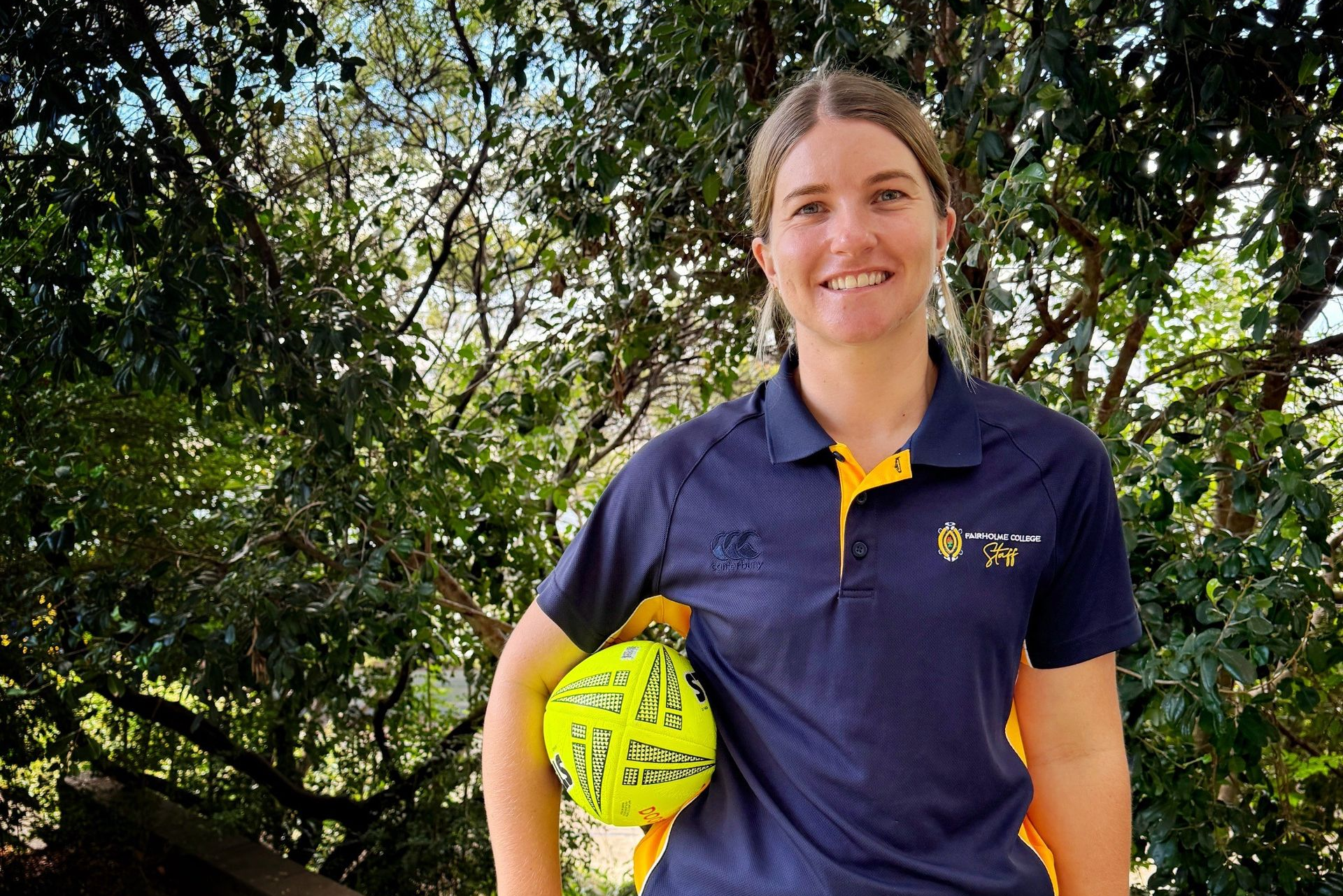
Fairholme College is delighted to welcome Mr Mitch Koina as our new Coordinator of High Performance Coaching. Bringing more than a decade of experience across diverse educational settings, Mitch joins the community with a strong commitment to student wellbeing, participation, and performance. ‘This is my 12th year of teaching,’ Mitch shares. ‘I’ve done a range of different contexts now, I did two years down at Lockyer District High School, I then spent six years at St Mary’s College before moving to St Josephs, where I’ve been for the last three years. Now obviously I’ve made my way over to Fairholme which I’m really excited about.’ It was both the College’s reputation and the scope of the role that drew Mitch to Fairholme. ‘Fairholme is a very prestigious college, it’s got a great name and reputation,’ he said. ‘The role itself is really exciting for me. I’ve got a passion for fitness and particularly looking after the wellbeing of young girls, whether that be on the sporting field or with their social aspect, academics, just all round developing good girls on and off the court.’ A strong advocate for pastoral care, Mitch brings valuable leadership experience to the position. ‘I did a Head of House role at St Mary’s for three and a half years, so pastoral care has always been my calling so it’s great to tie in the sporting aspect as well as wellbeing,’ he explained. His philosophy centres on the connection between student wellbeing and performance. ‘It’s all dependant on each other. If we’ve got girls who are happy and their wellbeing is flourishing, then they are doing well on the sporting field and vice versa too.’ Looking ahead, Mitch is focused on building both excellence and enjoyment within the program. ‘I would love to get participation rates very high. We have a lot of elite athletes here that I want to achieve and do really well, but I also want to work on girls enjoying their training, coming in and having a nice vibe around the sporting field and the training.’ Importantly, Mitch emphasises that success looks different for every student. ‘We’re not all Australian representatives, but if girls are working really hard and achieving to the best of their potential, whatever level that may be in the sporting arena, I think that’s a program we can be very proud of.’ As he begins his journey at Fairholme, Mitch is eager to connect with the community. ‘I’m really excited to be a part of Fairholme, it is a great opportunity. The staff and the students have been fantastic to me so far, but as the weeks go on, I’m really looking forward to getting to know the girls and building some relationships from there.’ We warmly welcome Mitch to Fairholme and look forward to the energy, care, and expertise he will bring to our High Performance Sports program.
March 4, 2026
What inspired you to apply for the Prefect for Sport position? I was inspired to go for this position as I have seen the passion that Fairholme as a community has for sport, and the true love and respect the staff have for athletes at the college. I wanted to work closely with the girls and staff to help progressing sport at Fairholme. Do you have a favourite sport? My favourite sport is touch football. It has given me so very much and I am forever grateful. What has been your proudest sporting moment so far? My proudest sporting moment so far was being fortunate enough to represent my country in the sport I love most. Who has been your biggest influence or role model in sport? My biggest role model in sport has to my parents. They never fail to push me towards things that might seem out of my comfort zone or scary. They constantly support me through everything and influence me to be the best version of myself on and off the field. What are you hoping to achieve this year as Prefect for Sport? I aim to inspire everyone to just have a go. By the end of my final year at Fairholme I hope I can inspire people to just get o ut of their comfort zones and try something new. What advice would you give your Year 7 self? I would tell my Year 7 self that in the big picture no one is going to judge you for trying your hardest and giving things ago! And not to put too much pressure on yourself! Do you hope to pursue sport after school? I wish to continue to play sport at a high level after school. whether that is through touch or rugby. Sport is a very important part of my life that will hopefully continue well after I leave school.
March 4, 2026
How long have you been involved in The Arts at Fairholme? Since I began here in Year 7, but before then I started playing piano and violin in Year 5. I have participated in a number of ensembles within the school and greatly enjoyed each of these. What does being the Prefect for The Arts mean to you? Personally, I think that being the Prefect for The Arts is primarily a role in which I can help to support other girls. I’m a designated person that girls can come to if they have any questions or concerns with anything regarding extracurricular artistic involvement, and I do a little to help with running some of the artistic aspects around the school, such as finding girls to volunteer for busking at events. But mostly, I think it is about being a positive promoter for the arts, and encouraging other girls to expand their world view to include creativity. Which art form do you enjoy most (e.g. music, drama, visual art, dance etc)? My main art form that I participate in is instrumental music, through my involvement in a few ensembles within the school on violin and piano. However, other art forms, like dancing during March Pasts or singing Shine Jesus Shine are pretty fun too. Do you have a most memorable Arts experience? I think that one of the most memorable Arts experiences that I have had has been at events where I have accompanied my grade, like when all the Year 11’s last year sung at the Valedictorian dinner and I played piano along with other instrumentalists in my grade, Tilly Anderson and Emma Salter. However, I think the most enjoyable Arts experience that I have had is playing Jingle Bell Rock at the boarding Christmas dinner last year, when the rest of my cohort stood around the piano singing. I felt that this was one of those excellent examples of how music can bring people together. What advice would you give to students who might be nervous about joining an arts activity? I would say that it is always worth giving something new a go. You’re much more likely to regret the chances you never took than the ones you do. I’m a strong believer that being involved in any form of extra-curricular activity is so beneficial for everyone; it expands your world view, you meet new people, and get outside your comfort zone. Each individual has something they are good at, and how are you going to find out what that is if you don’t try? Do you hope to continue with The Arts after school? Definitely. It has become such a big part of my life, and I honestly get so much enjoyment out of it. The great thing about the arts is that they are things that you can do at any time of your life. You’re never too old, that’s a skill you have for life. Other people can also get so much enjoyment out of the artistic abilities of others. Who doesn’t love to have someone who can sit around the camp-fire and play guitar, or create a beautiful piece of artwork?
All News